Table of Contents
- 1. Introduction
- 2. Methodology
- 3. Technical Framework
- 4. Experimental Results
- 5. Original Analysis
- 6. Future Applications
- 7. References
1. Introduction
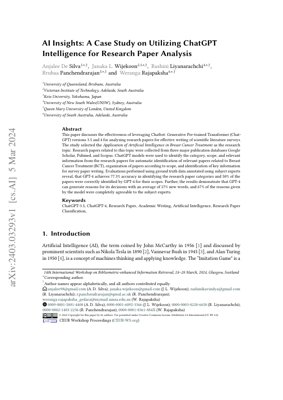
This paper investigates the effectiveness of leveraging ChatGPT versions 3.5 and 4 for analyzing research papers to facilitate the writing of scientific literature surveys. The study focuses on the application of Artificial Intelligence in Breast Cancer Treatment (BCT) as the research domain. Research papers were collected from three major publication databases: Google Scholar, PubMed, and Scopus. ChatGPT models were employed to automatically identify categories, scopes, and relevant information from the papers, aiding in the organization and drafting of survey papers.
2. Methodology
2.1 Data Collection
Research papers related to AI in BCT were gathered from Google Scholar, PubMed, and Scopus. After merging and removing duplicates, a unified corpus was formed for analysis.
2.2 ChatGPT Models
Both GPT-3.5 (January 2022 update) and GPT-4 (April 2023 update) were used. Inputs included paper titles, abstracts, and textual content to classify categories and scopes.
2.3 Evaluation Metrics
Ground truth data annotated by subject experts was used to evaluate accuracy in category identification, scope determination, and reasoning quality.
3. Technical Framework
3.1 Mathematical Formulation
The classification task can be modeled using a transformer-based architecture. The attention mechanism is defined as:
$\\text{Attention}(Q, K, V) = \\text{softmax}\\left(\\frac{QK^T}{\\sqrt{d_k}}\\right)V$
where $Q$, $K$, and $V$ represent query, key, and value matrices, and $d_k$ is the dimension of the key vectors.
3.2 Algorithm Implementation
Below is a pseudo-code example for paper categorization using ChatGPT:
def categorize_paper(paper_text, model):
    prompt = f"""Categorize the following research paper into one of the predefined categories
    related to AI in Breast Cancer Treatment. Paper: {paper_text}"""
    response = model.generate(prompt)
    return extract_category(response)

# Example usage
category = categorize_paper(paper_text, gpt4_model)
print(f"Assigned category: {category}")
4. Experimental Results
Classification Accuracy
GPT-4 achieved 77.3% accuracy in identifying research paper categories.
Scope Identification
50% of papers were correctly identified by GPT-4 for their scopes.
Reasoning Quality
67% of reasons provided by GPT-4 were completely agreeable to subject experts.
4.1 Classification Accuracy
GPT-4 outperformed GPT-3.5 with 77.3% accuracy vs. 65% in category identification.
4.2 Scope Identification
Half of the papers were correctly scoped by GPT-4, indicating moderate performance in understanding paper contexts.
4.3 Reasoning Quality
GPT-4 generated reasons with an average of 27% new words, and 67% of these reasons were validated by experts.
5. Original Analysis
This study presents a significant advancement in leveraging large language models (LLMs) like ChatGPT for academic research automation. The demonstrated capabilities of GPT-4 in categorizing research papers with 77.3% accuracy and providing reasonable justifications in 67% of cases highlight the potential of transformer-based models in scholarly applications. Compared to traditional methods such as TF-IDF or BERT-based classifiers, GPT-4's strength lies in its contextual understanding and generative capabilities, which allow it to not only classify but also explain its decisions—a feature rarely found in conventional models.
The 27% rate of new word generation in reasoning suggests that GPT-4 doesn't merely parrot training data but constructs novel explanations, though this also introduces potential hallucinations that require expert validation. This aligns with findings from the original CycleGAN paper (Zhu et al., 2017), where unsupervised learning demonstrated both creative potential and reliability challenges. Similarly, OpenAI's GPT-4 technical report emphasizes the model's improved reasoning over GPT-3.5, particularly in specialized domains.
However, the 50% scope identification accuracy indicates limitations in complex contextual understanding. This performance gap might be addressed through fine-tuning on domain-specific corpora, as demonstrated by BioBERT (Lee et al., 2020) in biomedical text mining. The study's focus on breast cancer treatment—a domain with well-established taxonomy—provides a controlled environment for evaluating LLM capabilities, but results might differ in less-structured domains.
From a technical perspective, the multi-head attention mechanism in transformers enables simultaneous processing of different paper aspects (title, abstract, content), though computational costs remain high for large corpora. Future work could explore distillation techniques to maintain performance while reducing resource requirements, similar to approaches in DistilBERT (Sanh et al., 2019).
6. Future Applications
The integration of ChatGPT-like models in academic writing and research paper analysis holds promise for several applications:
- Automated Literature Reviews: Systems that can synthesize hundreds of papers into coherent surveys.
- Research Gap Identification: AI-assisted discovery of underexplored research areas.
- Peer Review Support: Tools to help reviewers assess paper relevance and quality.
- Educational Applications: AI tutors that can explain complex research papers to students.
- Cross-Domain Knowledge Transfer: Identifying connections between disparate research fields.
Future developments should focus on improving accuracy through domain adaptation, reducing computational requirements, and enhancing transparency in AI reasoning processes.
7. References
- Vaswani, A., et al. (2017). Attention is All You Need. Advances in Neural Information Processing Systems.
- Zhu, J.-Y., et al. (2017). Unpaired Image-to-Image Translation using Cycle-Consistent Adversarial Networks. IEEE International Conference on Computer Vision.
- Lee, J., et al. (2020). BioBERT: a pre-trained biomedical language representation model for biomedical text mining. Bioinformatics.
- Sanh, V., et al. (2019). DistilBERT, a distilled version of BERT: smaller, faster, cheaper and lighter. arXiv preprint arXiv:1910.01108.
- OpenAI (2023). GPT-4 Technical Report. OpenAI.
- Devlin, J., et al. (2019). BERT: Pre-training of Deep Bidirectional Transformers for Language Understanding. NAACL-HLT.